Breaches of Ethics
Breaches of Beauty Ethics
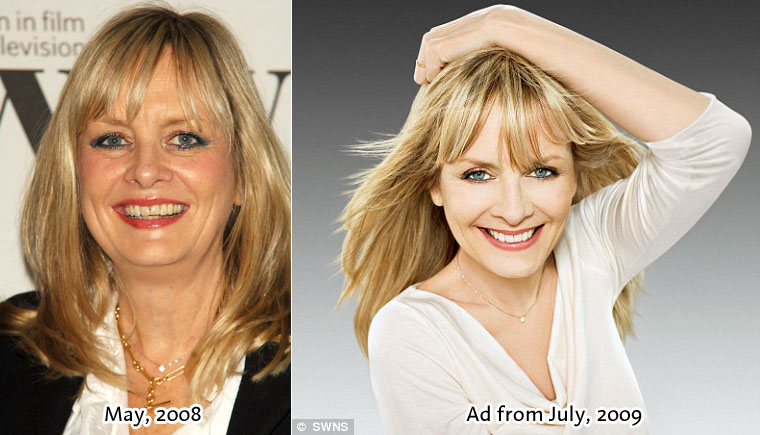
In today's world, it is hard for people to find beauty products that help fight against beauty marks and wrinkles. Each person's skin is different, and some products may not work the same on one person as they do on another. Then you get companies like this one that like to throw misleading information at you, claiming that their product will work on everyone. What they are not telling you is that in this case, they are photoshopping their models skin to look like every older woman's dream.
Personally, I have had my fair share of browsing through the internet trying to find anything that would work for my skin. Think of it like an experiment; each person will have some trial-and-error moments before they find what works best for their skin type. In my experience, I have learned that there is an abundance of misleading information in the beauty world. The unfortunate part about the misleading information is that you will never know until you do your own research and try it for yourself. Let's continue and discuss a huge matter that can cause conflict.
It is no big secret that beauty companies use some high-level editing skills on their models, but let's try to be a little more realistic with our Photoshop skills. I guarantee you that there is not one advertisement that you see that does not have some sort of Photoshop done to the model in order to make the product look more appealing. This makes me wonder what companies used to convince women to try their products before Photoshop was available. This tool has made it possible for companies to enhance and refine images, creating a flawless and, most of the time, unrealistic standard as to what a woman is going to look like when they use a product. I feel like it is safe to say that in today's society, women struggle with their appearance and body positivity. Photoshop allows the ability to retouch skin imperfections, do away with blemishes, and adjust facial features as the editor sees fit. In other words, models are transformed into someone they are not in order to show off the perfected version of beauty for product promotions. This is one of those scenarios where you can't believe everything you see on the internet because, most of the time, it is too good to be true.
In this case, Lesley Lawson, also known as Twiggy, was modeling for the beauty company Olay when they got a lot of backlash for the retouching they had done on Twiggy. The magazine ad was for Olay's under eye cream, and Twiggy claimed that "Olay is my secret to brighter-looing eyes." Olay continues to add in the magazine that "because younger-looking eyes never go out of fashion, it reduces the look of wrinkles and dark circles for brighter, younger-looking eyes." The Guardian states that "a magazine ad for an Olay beauty product featuring Twiggy has been banned by the advertising watchdog after more than 700 complaints gathered for a campaign against airbrushing in ads by Liberal Democrat MP Jo Swinson." This has obviously been an issue throughout the beauty industry, and people are wanting to put a stop to it. The fact is pretty simple: customers are tired of being lied to about the products they are using and the false advertising they are receiving from every direction. I am really not sure why you would Photoshop your model in the first place, considering a large group of people already know what she looks like or can just look her up.
We try telling women every day that they are good enough, beautiful, and do not need any special treatment in order to fit into this bubble that society says is beautiful. Then companies like this one will go out of their way to make a model digitally look "prettier" because obviously their product did not do its job. It also makes you wonder if they even used the product on the model at all for the photoshoot or just let the editing do all of the work. Olay should not be the only one we blame in this situation; unfortunately, they have just received the most hate for it.
According to Glamour, Olay claims that they will never retouch a model in the ads ever again, nor will you see any form of editing from partnered influencers. After Olay realized the damage they had done, they quickly shifted gears. The company is on the path to "zero skin retouching." A recent study shows that in the U.S., 40% of women believe that beauty advertising is unrealistic. To keep their word, Olay has partnered with CVS, which started a campaign against excessive Photoshop in beauty ads. Busy Phillips is one of the leaders in this new campaign for Olay, and she says, "For Olay to take this stand and say, 'We're about skin care; we're about having you feel your best and having you feel like your most confident self,' it's a really big deal. The more huge companies like Olay that can stand up, the better everyone's going to be. You want to see yourself reflected. You don't want to see something that's completely unattainable, because that's not real."

Personally, I think this is a great step in the right direction for the beauty world. This could lead to other beauty companies starting to follow suit with more natural, less edited products, which will bring out the products that are worth spending your money on. I think people and companies around the world are starting to realize the damage that unrealistic Photoshop has done. Olay is a large beauty brand, and if they are serious about taking this stand, then others will be right behind them. Other popular brands, like Aerie, are starting all-natural campaigns, standing up against unwanted Photoshop. All of this is being said with the hope of changing the minds of influencers around the world.

Comments
Post a Comment